

Help Men Work Out to Ease Depression



Fitness professionals can help their members understand how depression symptoms respond to exercise and this may be especially important for the men they serve. Even though one in three men experience depression during their lifetime,1 they are less likely than women to receive a diagnosis or treatment. Workouts ease depression symptoms, so your facility can be a crucial part of their symptom relief strategy.
Depression Differs in Men & Women
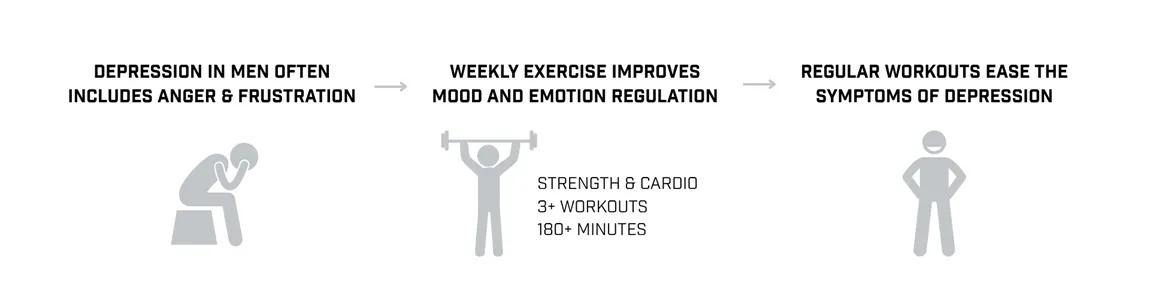
Men are often more reluctant to seek help due to stigma and social conditioning. In addition, depression symptoms differ in men and women, which can make them difficult to recognize. While depression involves sadness and fatigue, many men also notice frustration and anger as major symptoms.1,2

Your Facility Offers a Healthy Outlet
Anger is a natural but complex emotional response that involves heightened tension and alertness. One reason workouts support anger management is that this extra energy can be channeled into exercise,3 especially if the activity is at least moderate in intensity. Experiments that expose men to stressful, negative events show that a single cardio workout significantly reduces their anger and tension, whereas low-intensity movements like stretching do not.4
Another reason active people tend to manage anger better is that regular exercise enhances brain activity involved in emotion control.5 In fact, more frequent cardio workouts are associated with less severe depression symptoms.6 Think of exercise as a pressure-release valve. It allows emotional stress to be processed productively. Help your members understand that each visit supports their mental as well as physical health.
Can Exercise Replace Medication?
For more than a decade, mental health experts have been laying the groundwork for using exercise as a prescription-strength treatment for depression.6 Recent analyses confirm that, on average, starting regular exercise is as effective as psychotherapy and antidepressants for the common symptoms of depression.7 In cases where antidepressants are already being used, adding exercise improves outcomes, indicating that combination treatments may provide ideal results.8
It’s important to realize that severe depression symptoms involve low energy and motivation, making exercise tough to initiate. Fitness professionals should frame exercise as a valuable part of a broader treatment strategy. This aligns with research that emphasizes the effective depression relief from a combination of exercise and medication 8 or behavioral therapy.9,10
Best Practices for Depression-Relief Workouts
Many types of exercise are effective. For instance, yoga and walk/jog intervals significantly ease depression symptoms, though progressing to higher intensity workouts is recommended because they deliver larger mood improvements.7,11 The most effective routines for depression relief offer a blend of strength and cardiovascular training for three or more workouts totaling at least 180 minutes per week.8,11,12
Men Need the Mental Health Benefits of Movement
Men often face unique challenges when it comes to mental health. Stigma, fear of appearing weak and limited access to relatable resources can all contribute to underdiagnosis and a lack of treatment. Movement provides a practical, empowering way for men to protect their mental well-being.
Action Steps for Fitness Professionals
As a coach, trainer or gym operator, you are in a powerful position to normalize conversations around mental health. By pointing clients to movement as a mental health strategy, creating a judgment-free zone and recognizing the signs of emotional burnout, you can offer a bridge to better health.
- Share the science: Use newsletters or social posts to highlight that regular cardio can ease depression symptoms and improve emotion regulation.
- Create space: Offer group exercise or small group training options with mental health in mind. That means low-pressure, high-connection sessions that foster camaraderie as members get their comprehensive workouts completed.
- Check in: Encourage your male members to see movement as part of their total health strategy, not just for their physical strength or physique.
Men do not have to navigate depression alone. Your facility can help turn isolation into engagement and provide a consistent space for emotional support. Remind the men in your community that moving their bodies can be a powerful and practical step toward feeling better.

Karlie Intlekofer, PhD, CNC, CPT
References
- Martin et al. The experience of symptoms of depression in men vs women: Analysis of the National Comorbidity Survey Replication. JAMA Psych 2013; 70(10): 1100-6.
- Genuchi & Valdez. The role of anger as a component of a masculine variation of depression. Psychol Men Masculinities 2015; 16(2): 149-59.
- Shahbazzadeh & Beliad. The mediatory role of exercise self-regulation in the relationship between personality traits and anger management of athletes. Int Educ Stud 2017; 10(5): 181-8.
- Edwards et al. A randomized control intervention investigating the effects of acute exercise on emotional regulation. Am J Health Behav 2017; 41(5): 534-43.
- Wu et al. Relationship between physical activity and emotional regulation strategies in early adulthood: Mediating effects of cortical thickness. Brain Sci 2022; 12(9): 1210.
- Bernstein & McNally. Exercise as a buffer against difficulties with emotion regulation: A pathway to emotional wellbeing. Behav Res Ther 2018; 109; 29-36.
- Rethorst & Trivedi. Evidence-based recommendations for the prescription of exercise for major depressive disorder. J Psychiatr Pract 2013; 19(3); 204-12.
- Lee et al. Efficacy of exercise combined with standard treatment for depression compared to standard treatment alone: A systematic review and meta-analysis of randomized controlled trials. J Affect Disord 2021; 295: 1494-1511.
- Bourbeau et al. The combined effect of exercise and behavioral therapy for depression and anxiety: Systematic review and meta-analysis. Behav Sci 2020; 10(7): 116.
- Abdollahi et al. Effect of exercise augmentation of cognitive behavioural therapy for the treatment of suicidal ideation and depression. J Affect Disord 2017; 219: 58-63.
- Noetel et al. Effect of exercise for depression: Systematic review and network meta-analysis of randomised controlled trials. BMJ 2024; 384, e075847.
- Wang et al. Impact of combined resistance and aerobic training on depression: A systematic review and meta-analysis of randomized controlled trials. BMC Sports Sci Med Rehabil 2025; 17: 10.


