This website uses cookies
We use cookies to personalise content and ads, to provide social media features and to analyse our traffic. We also share information about your use of our site with our social media, advertising and analytics partners who may combine it with other information that you’ve provided to them or that they’ve collected from your use of their services.
Consent Selection
Details
  • Necessary cookies help make a website usable by enabling basic functions like page navigation and access to secure areas of the website. The website cannot function properly without these cookies.
    • Learn more about this provideropens in a new window
      CookieConsentStores the user's cookie consent state for the current domain
      Maximum Storage Duration: 1 yearType: HTTP Cookie
    • Learn more about this provideropens in a new window

      Some of the data collected by this provider is for the purposes of personalization and measuring advertising effectiveness. The provider may use the IP Addresses for ads measurement and ads personalization.

      test_cookieUsed to check if the user's browser supports cookies.
      Maximum Storage Duration: 1 dayType: HTTP Cookie
    • Learn more about this provideropens in a new window
      __cf_bmThis cookie is used to distinguish between humans and bots. This is beneficial for the website, in order to make valid reports on the use of their website.
      Maximum Storage Duration: 1 dayType: HTTP Cookie
      cf_clearanceThis cookie is used to distinguish between humans and bots.
      Maximum Storage Duration: 1 yearType: HTTP Cookie
  • Preference cookies enable a website to remember information that changes the way the website behaves or looks, like your preferred language or the region that you are in.
    • We do not use cookies of this type.

  • Statistic cookies help website owners to understand how visitors interact with websites by collecting and reporting information anonymously.
    • Learn more about this provideropens in a new window
      p.gifKeeps track of special fonts used on the website for internal analysis. The cookie does not register any visitor data.
      Maximum Storage Duration: SessionType: Pixel Tracker
    • Learn more about this provideropens in a new window

      Some of the data collected by this provider is for the purposes of personalization and measuring advertising effectiveness. The provider may use the IP Addresses for ads measurement and ads personalization.

      _gaUsed to send data to Google Analytics about the visitor's device and behavior. Tracks the visitor across devices and marketing channels.
      Maximum Storage Duration: 2 yearsType: HTTP Cookie
      _ga_#Used to send data to Google Analytics about the visitor's device and behavior. Tracks the visitor across devices and marketing channels.
      Maximum Storage Duration: 2 yearsType: HTTP Cookie
  • Marketing cookies are used to track visitors across websites. The intention is to display ads that are relevant and engaging for the individual user and thereby more valuable for publishers and third party advertisers.
    • Learn more about this provideropens in a new window

      Some of the data collected by this provider is for the purposes of personalization and measuring advertising effectiveness. The provider may use the IP Addresses for ads measurement and ads personalization.

      pagead/1p-user-list/#Tracks if the user has shown interest in specific products or events across multiple websites and detects how the user navigates between sites. This is used for measurement of advertisement efforts and facilitates payment of referral-fees between websites.
      Maximum Storage Duration: SessionType: Pixel Tracker
      _gcl_auUsed to measure the efficiency of the website’s advertisement efforts, by collecting data on the conversion rate of the website’s ads across multiple websites.
      Maximum Storage Duration: 3 monthsType: HTTP Cookie
      _gcl_lsTracks the conversion rate between the user and the advertisement banners on the website - This serves to optimise the relevance of the advertisements on the website.
      Maximum Storage Duration: PersistentType: HTML Local Storage
    • Learn more about this provideropens in a new window
      __cf_obPending
      Maximum Storage Duration: SessionType: HTTP Cookie
      _cfPre_tabIdPending
      Maximum Storage Duration: SessionType: HTML Local Storage
    • Learn more about this provideropens in a new window
      __Secure-BUCKETPending
      Maximum Storage Duration: 180 daysType: HTTP Cookie
      __Secure-ROLLOUT_TOKENUsed to track user’s interaction with embedded content.
      Maximum Storage Duration: 180 daysType: HTTP Cookie
      __Secure-YECStores the user's video player preferences using embedded YouTube video
      Maximum Storage Duration: SessionType: HTTP Cookie
      __Secure-YNIDUsed to track user’s interaction with embedded content.
      Maximum Storage Duration: 180 daysType: HTTP Cookie
      LAST_RESULT_ENTRY_KEYUsed to track user’s interaction with embedded content.
      Maximum Storage Duration: SessionType: HTTP Cookie
      LogsDatabaseV2:V#||LogsRequestsStoreUsed to track user’s interaction with embedded content.
      Maximum Storage Duration: PersistentType: IndexedDB
      ServiceWorkerLogsDatabase#SWHealthLogNecessary for the implementation and functionality of YouTube video-content on the website.
      Maximum Storage Duration: PersistentType: IndexedDB
      TESTCOOKIESENABLEDUsed to track user’s interaction with embedded content.
      Maximum Storage Duration: 1 dayType: HTTP Cookie
      VISITOR_INFO1_LIVETries to estimate the users' bandwidth on pages with integrated YouTube videos.
      Maximum Storage Duration: 180 daysType: HTTP Cookie
      YSCRegisters a unique ID to keep statistics of what videos from YouTube the user has seen.
      Maximum Storage Duration: SessionType: HTTP Cookie
      yt-icons-last-purgedNecessary for the implementation and functionality of YouTube video-content on the website.
      Maximum Storage Duration: PersistentType: HTML Local Storage
      YtIdbMeta#databasesUsed to track user’s interaction with embedded content.
      Maximum Storage Duration: PersistentType: IndexedDB
  • Unclassified cookies are cookies that we are in the process of classifying, together with the providers of individual cookies.
    • matrix_last_commercial_productPending
      Maximum Storage Duration: SessionType: HTML Local Storage
Cookie declaration last updated on 10/4/26 by Cookiebot
[#IABV2_TITLE#]
[#IABV2_BODY_INTRO#]
[#IABV2_BODY_LEGITIMATE_INTEREST_INTRO#]
[#IABV2_BODY_PREFERENCE_INTRO#]
[#IABV2_BODY_PURPOSES_INTRO#]
[#IABV2_BODY_PURPOSES#]
[#IABV2_BODY_FEATURES_INTRO#]
[#IABV2_BODY_FEATURES#]
[#IABV2_BODY_PARTNERS_INTRO#]
[#IABV2_BODY_PARTNERS#]
About
Cookies are small text files that can be used by websites to make a user's experience more efficient.

The law states that we can store cookies on your device if they are strictly necessary for the operation of this site. For all other types of cookies we need your permission.

This site uses different types of cookies. Some cookies are placed by third party services that appear on our pages.

You can at any time change or withdraw your consent from the Cookie Declaration on our website.

Learn more about who we are, how you can contact us and how we process personal data in our Privacy Policy.

Please state your consent ID and date when you contact us regarding your consent.

Choose Challenge Over Comfort For Results

December 12, 2024

women doing sprint8

As workouts become more familiar, most people ease up on intensity. This tendency to favor comfort over challenge is hardwired into our physiology and can be a barrier to achieving the desired results. Fitness professionals can help their members understand the exercise intensity categories so they can continue to improve their strength and fitness.

An Exercise Paradox

Why does the body want to take it easy? At the core of this exercise paradox is the body’s preference for efficiency. When presented with a choice, most will instinctively opt for the path of least resistance, conserving energy and avoiding unnecessary effort. While this trait has helped our ancestors in times of scarcity, in the context of strength and fitness, it hinders progress.

Comfort Creates Plateaus

When members unknowingly fall into this trap of comfortable workouts, they often hit a plateau. This stall in progress can be demotivating, but you can help your members by reminding them that intensity is key for continued results.

Why Training History Matters

Although all levels of intensity provide some benefits, higher intensities are a catalyst for continued physical improvements. Your members’ training history influences the intensities they must attain to keep making progress.
Strength

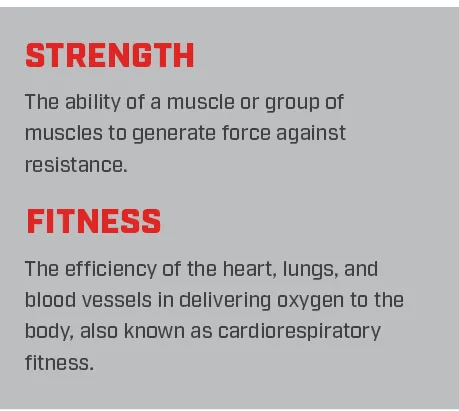
Compared to seasoned lifters, those new to regular exercise improve their strength with much lower intensity workouts. For example, research1 indicates that regular strength training at least twice a week allows untrained individuals to gain strength at an average intensity of just 60% of their 1 repetition maximum (RM). Yet for recreationally trained individuals (most of gym-goers), strength improvements are realized by reaching about 80% of their 1 RM. Advanced athletes have already capitalized on these gains, so they must reach about 85% of their 1 RM for further strength gains.

Fitness

Similar to strength, the minimum intensity necessary for improvement is very low for untrained individuals. This means that untrained people can improve their fitness by working at about 50%2 of their highest achievable heart rate. In contrast, advanced athletes need to reach over 85%3 of their highest achievable heart rate to continue to improve their fitness level.

3 Tips to Introduce Intensity Without Intimidation:

1. Personalized Progression: Introduce intensity in manageable steps by setting small, achievable goals. For example, suggest adding a short jog to a walking workout or trying a slightly heavier weight for just one set. These offer signs of gradual progress that help members to feel successful, boosting confidence and showing them that intensity is a tool for growth. Celebrating these small wins keeps them motivated and open to pushing further.

2. Share Real-Life Intensity Wins: Use stories from trainers and members to demonstrate how embracing intensity accelerates results. Sharing relatable progress stories can connect intensity to practical, everyday benefits. For instance, share how a member improved their stamina for weekend hikes or gained the strength to pick up their grandchildren with ease. These stories make higher intensities more approachable and meaningful to daily life.

3. Create an Encouraging Culture: Build a community where effort, not just results, is celebrated. Recognize members for their hard work, regardless of their strength or fitness level. A supportive atmosphere welcomes higher intensities and enhances camaraderie, helping members embrace intensity as part of a shared, uplifting experience.

Remind Members to Embrace Effort

Help your members see effort as the cornerstone of growth. As the exercise paradox clarifies, our bodies are inclined to conserve energy, which can make effortful exercise feel like something to avoid. This instinct, however, is exactly what makes exercise transformative.

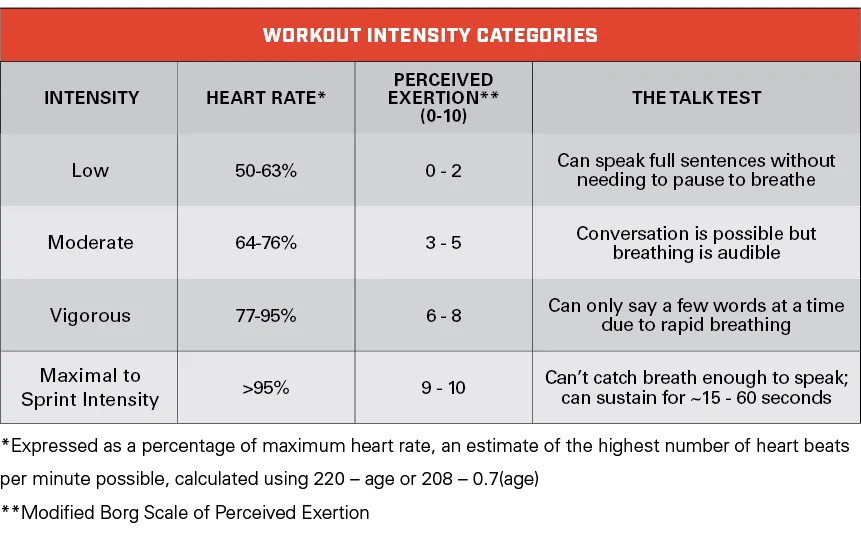
Encourage members to reframe their effort as a pathway to progress, associating their sweat and hard work with real results. Share with them a chart of how to monitor their perceived exertion, or suggest they monitor heart rates to help them understand the levels of intensity. Just remember that higher intensities require more recovery time4 as you help members push through plateaus. With this mindset, they’re more likely to embrace the consistency needed to achieve lasting change.
workout intensity categories